Standardising IT Across a MAT Without Ignoring School Context
asitplan Strategy Team
Author
Rob Lloyd
Technical Reviewer
06 August 2026
Last Reviewed
MAT executives, trustees, and central IT leadership
Target Audience
The Context
As Multi-Academy Trusts (MATs) acquire new schools, they often inherit a variety of legacy, siloed IT setups. The immediate organisational instinct is often aggressive centralisation and standardisation to drive efficiency. However, forcing every school into an identical technological mould can alienate staff and overlook unique educational contexts (e.g., the distinct needs of primary versus secondary education, or specialist provisions).
Who This Guide is For
MAT executives, trustees, and central IT leadership.
Why This Matters
Over-standardisation can stifle teaching innovation and create unnecessary friction between the central team and the schools. Conversely, under-standardisation leads to support inefficiencies, severe compliance blind spots, and duplicated procurement costs. Striking the right balance is critical for sustainable MAT growth.
What Good Looks Like
A structured oversight model where foundational elements—such as identity management, core networking, and cyber security—are rigorously standardised across the Trust, while endpoint devices and classroom technologies retain sufficient flexibility to suit local pedagogical requirements.
Approach and Methodology
- Define the Non-Negotiables: Establish central minimum standards for security and infrastructure (e.g., a unified approach to identity, mandatory Multi-Factor Authentication for staff, and standard firewall configurations).
- Permit Legitimate Local Variation: Allow schools autonomy in areas that directly impact teaching, provided they meet the central security baseline. For example, a school might choose between Google Chromebooks or Windows devices based on their curriculum, as long as both integrate securely with the central identity system.
- Rigorous Baseline Discovery: Before imposing new standards on a joining school, conduct a comprehensive discovery audit to understand their existing technical debt and contractual obligations.
- Sequenced Transition: Avoid attempting to standardise everything in the first year of a school joining the Trust. Sequence changes logically: often addressing high-risk security first, core identity second, and curriculum devices third.
- Stakeholder Engagement: Involve headteachers and local staff in the standardisation roadmap so they understand the financial, operational, and safeguarding benefits of the changes, rather than feeling they are simply being dictated to.
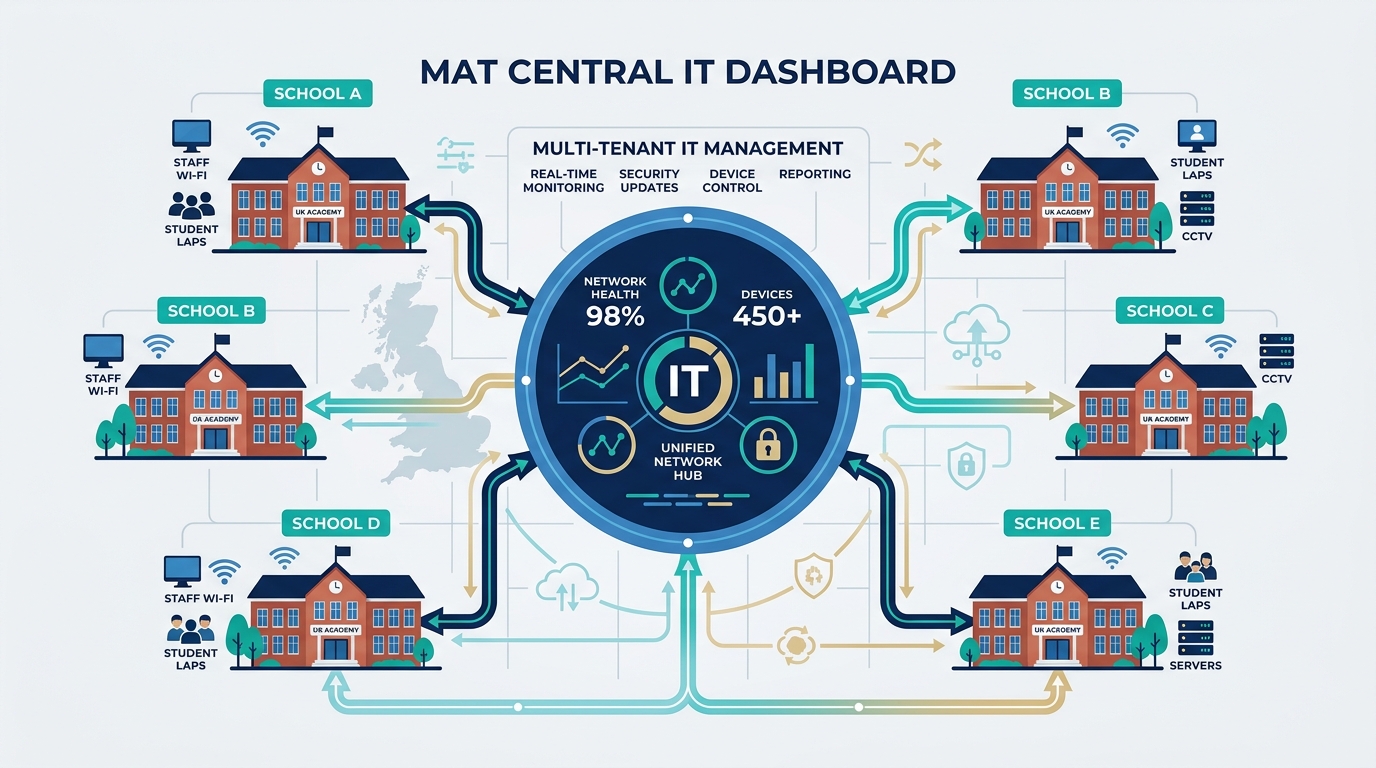
- Measuring Progress: Track the standardisation journey of each school against the MAT baseline using a unified, objective dashboard to identify which academies need additional support.
Evidence to Retain
- The MAT IT Target Operating Model (TOM) or central IT strategy document.
- A standardisation progress dashboard tracking all academies.
- A formally approved exceptions log for schools temporarily deviating from the baseline (e.g., waiting for an existing contract to expire).
Questions Leadership Should Ask
- "Are we standardising this technology because it improves security and education, or simply because it makes IT support easier?"
- "Do we have clear visibility of which schools are currently deviating from our minimum security standards, and what is the plan to address this?"
Common Pitfalls
- The Cookie-Cutter Approach: Ignoring the distinct needs of different school phases (Primary, Secondary, SEND) and providing identical equipment to all.
- Change Management Failure: Rolling out central systems without adequately training local staff or explaining the rationale, leading to low adoption.
- Ignoring Existing Contracts: Attempting to force standardisation while schools are still locked into expensive, multi-year legacy contracts, resulting in double-paying.
How asitplan Can Help
asitplan provides MATs with a central platform to map and compare the technical posture of multiple academies. It allows central teams to establish a baseline standard and visually track the progress of each school as they migrate towards the Trust's Target Operating Model, highlighting deviations and technical debt along the way.