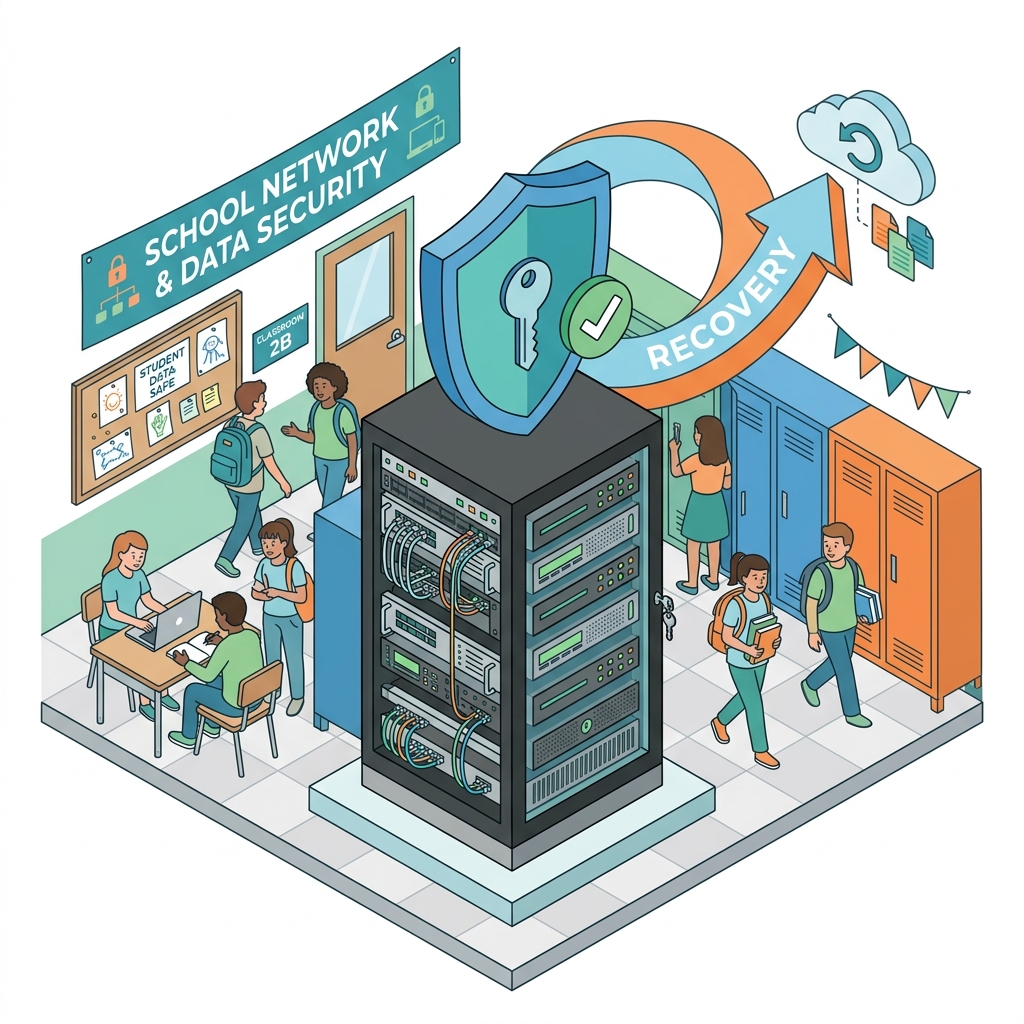
Testing Backup Recovery: Gathering the Evidence That Actually Matters
asitplan Security Team
Author
Rob Lloyd
Technical Reviewer
06 August 2026
Last Reviewed
IT managers, network administrators, and business leaders
Target Audience
The Context
Ransomware operators intentionally target school backups to ensure maximum leverage during an extortion attempt. Despite this, many schools rely entirely on automated emails stating "Backup Job Successful" as their only proof of resilience. They rarely, if ever, attempt a full system restore until a catastrophic failure occurs.
Who This Guide is For
IT managers, network administrators, and school business leaders.
Why This Matters
If you cannot restore your data, you do not have a backup; you merely have a copy of your data that is equally vulnerable. Discovering that your backups are corrupted, inaccessible, or encrypted by ransomware during a live cyber incident is the worst possible time to learn your strategy has failed.
What Good Looks Like
A resilient backup strategy follows the 3-2-1 rule (3 copies of data, on 2 different media, with 1 copy offsite/immutable). Crucially, "good" requires scheduled, documented, and timed restore tests of critical systems to prove the data is viable and recovery time objectives (RTOs) can be met.
Approach and Methodology
- Define Criticality: You cannot restore everything instantly. Determine which systems are critical for immediate operational continuity (e.g., MIS, Finance, safeguarding files) versus those that can wait (e.g., archived student projects).
- Implement Immutability: Ensure your primary backup solution supports immutability (data cannot be altered or deleted for a set period, even by a Global Admin). This is your defense against ransomware.
- The File-Level Restore Test: Weekly, attempt to restore a randomly selected file or folder to verify the backup catalog is intact and accessible.
- The Full-System Restore Test: At least annually (preferably bi-annually), conduct a full disaster recovery test. Restore a critical server (like the MIS or a domain controller) into an isolated test environment.
- Time the Recovery: Measure how long the full restore takes. If it takes 4 days to download your cloud backups, your school will be closed for 4 days. Compare this against the board's expectations.
- Document the Failure: If a restore test fails, document why it failed and what configuration changes were made to resolve the issue.
Evidence to Retain
- An automated report confirming the backup schedule and immutability settings.
- Documented logs and screenshots of the successful full-system restore tests, including the time taken.
- The school's formal Incident Response and Disaster Recovery Plan.
Questions Leadership Should Ask
- "When was the last time we completely restored our central management system from a backup, and how long did it take?"
- "If our network administrator's account is compromised, can the attacker delete our cloud backups?"
Common Pitfalls
- The Syncing Illusion: Believing that syncing files to OneDrive or Google Drive is a backup. Syncing replicates ransomware encryption instantly; it does not protect against it.
- Testing in Production: Attempting to restore a server directly over the live production server during a test, causing an accidental outage.
- Ignoring Configuration Backups: Backing up the files but forgetting to backup the firewall rules, switch configurations, and Wi-Fi controller settings required to make the network function.
How asitplan Can Help
asitplan allows you to log your backup architecture and schedule your mandatory restore tests as recurring compliance tasks. By storing the evidence of successful restores centrally, IT teams can confidently demonstrate their disaster recovery readiness to leadership and external auditors.